Fintech · Payments · Wallets
Turning benefits into a payment experience.
Over a 2.5-year journey, I helped transform a traditional voucher and benefit ecosystem into a seamless wallet-based Tap-to-Pay experience.
The goal was not to design another redemption flow. It was to rethink how benefits behave in the real world, making them feel as simple, trusted, and familiar as paying with a card.
2.5 Years
End-to-end product journey
Wallet Ecosystem
Apple & Google Wallet experience
Millions
Potential end users
Cross-functional
Ownership across product, tech, QA, support, and business teams
Product Transformation
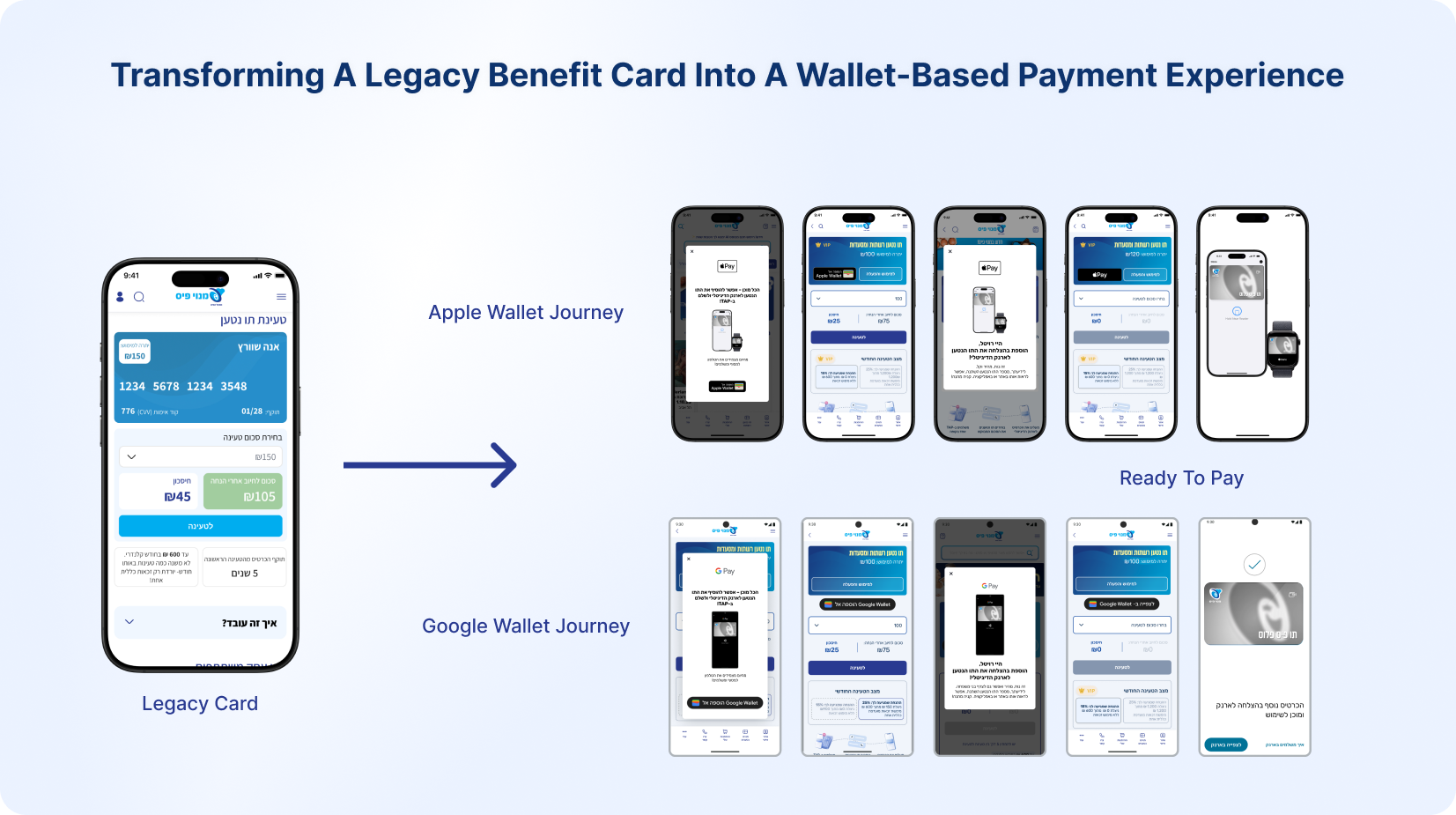
Transforming a legacy benefit card into a wallet-based payment experience.
This project transformed a traditional closed-loop benefit card into a modern wallet-based payment ecosystem supporting Apple Wallet, Google Wallet, provisioning, wallet management, and tap-to-pay transactions.
System Overview
From benefit to tap.
The user sees one simple action: tap. Behind that moment, multiple systems need to work together seamlessly.
The Challenge
The problem was bigger than payments.
Traditional benefit systems relied on fragmented redemption methods — physical cards, vouchers, codes, manual processes, and support-heavy flows.
For users, this created confusion at the exact moment that should feel the most simple: checkout. For businesses, it created operational friction, inconsistent experiences, and limited scalability.
The challenge was not just improving redemption. It was rethinking the entire model.
“What if benefits behaved like a payment card?”
From fragmented redemption to a wallet-based payment flow.
Before
- VouchersUsers needed to understand benefit logic before checkout.
- CodesRedemption depended on manual entry or cashier handling.
- Plastic CardsPhysical cards created dependency, loss risk, and operational complexity.
- Manual RedemptionThe experience varied across merchants, channels, and scenarios.
After
- Wallet CardThe benefit becomes accessible through a familiar payment behavior.
- TapUsers pay in a way they already understand.
- Instant RedemptionThe payment moment becomes faster, clearer, and easier to trust.
- Scalable InfrastructureThe experience can support more organizations, merchants, and use cases.
My Role
Leading product design across a complex ecosystem.
As the lead product designer on the initiative, I owned the end-to-end user experience throughout a multi-year product journey — from early discovery and product framing to wallet flows, edge cases, documentation, QA support, and implementation readiness.
This was not a screen-by-screen design task. It required translating business logic, technical limitations, wallet requirements, and real-world user behavior into one clear product experience.
- UX strategy and product thinking
- Journey mapping and flow definition
- Wallet onboarding and payment experience
- Card states and system behavior
- Edge-case mapping
- UX/UI design from concept to production
- Developer and QA collaboration
- Support and operational scenarios
- Stakeholder alignment
- Certification readiness and documentation
Timeline
A multi-year product journey.
- 2023Framing the opportunity
Mapped the ecosystem, existing redemption flows, stakeholder needs, and user friction around traditional benefit usage.
- 2024Designing wallet-based journeys
Defined the core experience: card creation, wallet onboarding, payment readiness, balance visibility, and user-facing states.
- 2025Scaling for complexity
Expanded edge cases, system states, technical constraints, QA scenarios, and certification-related flows.
- 2026Preparing for implementation
Aligned the product experience with operational realities, support needs, development execution, and launch readiness.
Ecosystem
Designing beyond the screen.
Before designing the interface, I needed to understand the system behind it.
The experience touched users, merchants, wallet providers, payment infrastructure, card issuing logic, support teams, operations, compliance, product, development, and QA.
Every design decision had to work not only for the user, but also for the systems and teams responsible for making the experience reliable in production.
Research & Discovery
Understanding trust in payments.
Payment experiences are not only about speed. They are about confidence.
Before designing the solution, I focused on understanding where trust breaks down: when users do not understand what they have, how to use it, whether it is active, what happens after adding it to Wallet, and what to expect at checkout.
The research process included mapping existing redemption journeys, analyzing support pain points, reviewing wallet behavior, identifying merchant-side friction, and translating stakeholder knowledge into clear product requirements.
- Existing redemption journeys
- User confusion around benefits and payment readiness
- Merchant and checkout scenarios
- Wallet onboarding behavior
- Support and troubleshooting cases
- Technical and operational constraints
- Edge cases across devices and card states
“People do not think about payment infrastructure. They think: “Will this work when I tap?””
System Thinking
Mapping the invisible system.
The final experience needed to feel simple, but the system behind it was complex.
A single tap depends on a chain of events: benefit purchase, card issuance, provisioning, Wallet activation, payment authorization, merchant acceptance, settlement, and balance update.
My role was to map that complexity and turn it into a clear, reliable experience that users could understand without needing to know what happens behind the scenes.
Benefit Purchase
Card Issuance
Provisioning
Wallet Activation
Tap at POS
Authorization
Settlement
Balance Update
“The best UX in this project was not adding more explanations. It was making the complexity feel invisible.”
Final Experience
From onboarding to wallet-ready payment.
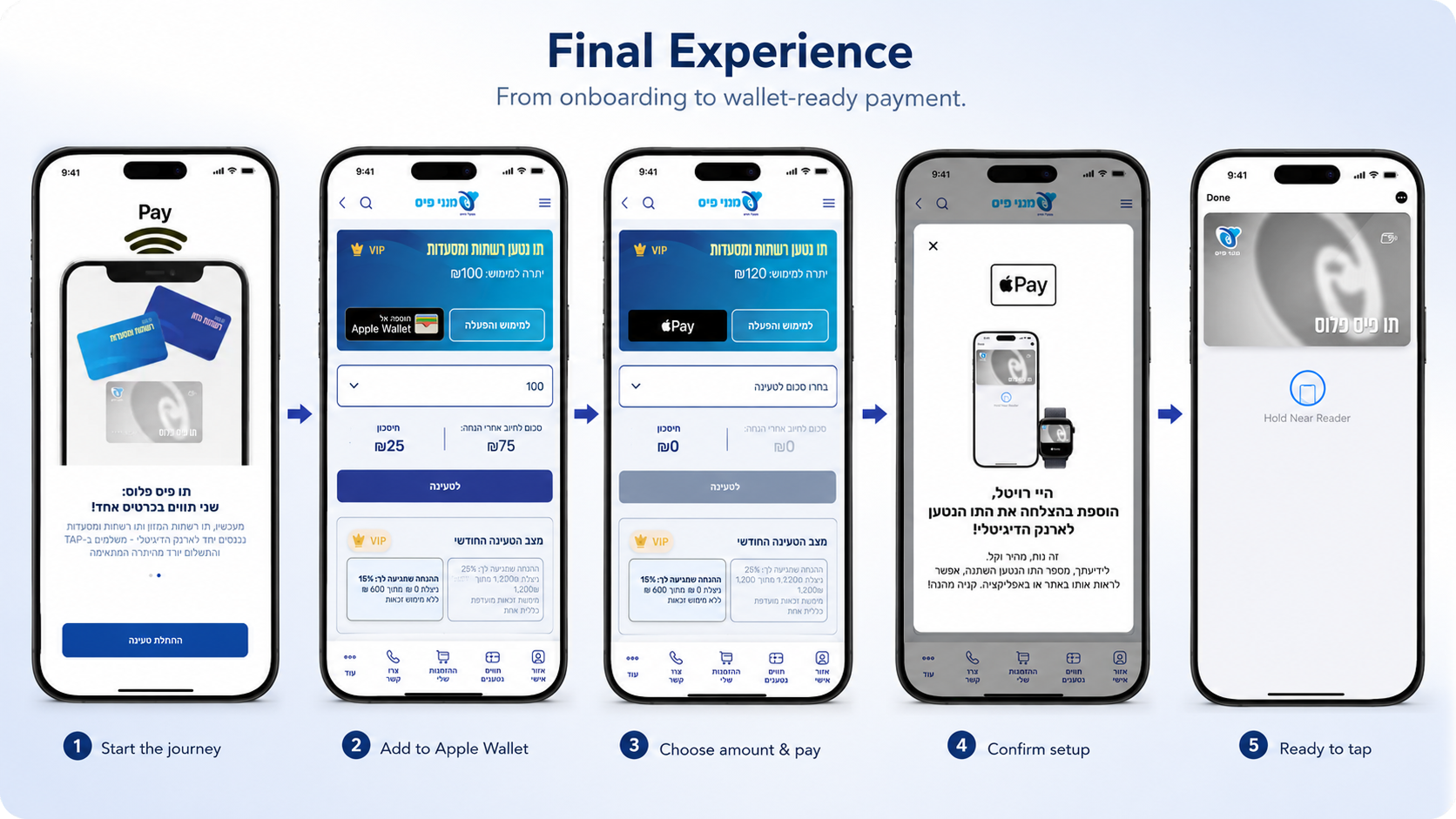
The end-to-end journey users actually experience — starting the journey, adding the card to Apple Wallet, choosing an amount and paying, confirming setup, and tapping to pay.
UX Decisions
Critical product decisions.
Stop calling it a voucher.
- Problem
- Users associate vouchers with limitations, manual redemption, codes, and friction.
- Decision
- Reframe the experience as a payment method rather than a voucher redemption flow.
- Outcome
- A clearer mental model that feels closer to everyday payment behavior.
Design wallet-first behavior.
- Problem
- Adding a card to Wallet can feel like an extra technical step if the value is not clear.
- Decision
- Make Wallet feel like the natural destination of the benefit, not a secondary action.
- Outcome
- Reduced cognitive load and created a more familiar path toward payment readiness.
Make status and balance understandable.
- Problem
- Users need to know if the card is active, ready to use, and how much value is available.
- Decision
- Define clear states for balance, activation, provisioning, card readiness, and post-payment behavior.
- Outcome
- More confidence before checkout and fewer moments of uncertainty.
Design for production, not just the happy path.
- Problem
- Real users do not always follow the ideal flow. Cards can be deleted, suspended, replaced, added to multiple devices, or fail during provisioning.
- Decision
- Map edge cases early and design states that could support real-world behavior.
- Outcome
- A stronger, more scalable product foundation for development, QA, support, and certification readiness.
Edge Cases
Designing for what happens next.
A significant part of the project focused on states users rarely think about — but product teams must anticipate.
In payment products, edge cases are not small details. They define whether the product feels reliable when something goes wrong.
I mapped the main scenarios across card lifecycle, device behavior, wallet status, provisioning errors, support flows, and system limitations.
What happens when a user removes the card from Wallet?
How should the system behave when a card is temporarily blocked?
What does the user see when Wallet behavior is unavailable?
How do we explain failure without creating panic?
How does the experience behave across more than one device?
What happens when the card cannot be added successfully?
How do we guide users back to the correct state?
How do we explain a one-time change clearly?
What happens when the system does not respond immediately?
How do we prevent users from losing trust in the card?
“A payment experience is only as good as its weakest edge case.”
Collaboration
Beyond design.
This project required close collaboration across product, development, QA, operations, support, business stakeholders, and external wallet/payment ecosystems.
Many UX decisions were shaped by technical, operational, and regulatory realities. My job was to make those constraints understandable, translate them into clear user flows, and keep the experience coherent across all teams.
“The more complex the system became, the more important clarity became — in the product, in the documentation, and in the conversations between teams.”
Impact
From redemption flow to scalable payment foundation.
The project created a foundation for wallet-based benefit experiences and helped bridge traditional loyalty systems with modern payment behavior.
Instead of relying on fragmented voucher logic, the experience reframed benefits as something users already understand: a payment method.
- Reframed benefits as a payment experience rather than a redemption flow
- Created a reusable foundation for wallet-based closed-loop payments
- Reduced reliance on fragmented voucher, code, and manual redemption logic
- Improved clarity around card status, balance, activation, and readiness
- Supported future scalability across organizations, merchants, and ecosystems
- Helped align product, development, QA, support, and business teams around one coherent flow
“The result was not just a new feature. It was a new product behavior.”
Lessons
What I learned from designing payments.
Trust is the product.
In payment experiences, users need to feel confident before they tap — not only after the transaction succeeds.
Complexity should be invisible.
The system can be complex, but the user experience cannot be.
Edge cases are product design.
The moments that happen outside the happy path often define the quality of the product.
Senior design is about systems.
This project taught me that strong product design is not just about screens — it is about decisions, dependencies, collaboration, and execution.
“This project was about making a complex financial system feel like one simple tap.”